
Navegar por los elementos
Actas del II Congreso Nacional El Conocimiento como Espacio de Encuentro : recopilación de papers

Position: 18 (469 views)
Mónica Vázquez

Position: 526 (59 views)
The importance of being pluricultural: blooming with the other

We have been inspired to write this work thanks to our experiences for one academic year as Foreign Language Teaching Assistants (FLTA) in Aberdeenshire, Scotland, and Arkansas, USA; respectively granted by British Council- and Fulbright-Ministerio de Educación. Our duties as FLTAs consisted in helping in speaking and writing sessions, testing, teaching, designing materials, and being in charge of cultural activities related to food and dance in secondary schools and universities. Today’s globalized world has permeated education, and interculturality has recently been integrated in the English as a Foreign/Second Language classroom, broadening the language experience by including cultural aspects in a lesson. This is why we believe that understanding others is essential for communication and cooperation. As Sercu (2005) states, “foreign language education is, by definition, intercultural. Bringing a foreign language to the classroom means connecting learners to a world that is culturally different from their own” and promoting “the acquisition of intercultural competence in the learners” (Sercu 2005: 1). When teaching a foreign language, diverse forms of living and understanding the world get into the classroom by means of audiovisual materials, texts, talks, coursebooks and realia. Thanks to these sources, all members in the FL classroom can discover a foreign culture and contrast it with their own. The underlying aim is to work with and form pluricultural individuals, i.e. learners with the ability to recognize others and be aware of their own traditions and values. As it is not always essential to travel abroad to be pluriculturally competent, some practical ideas will be shown as a way of exemplifying lessons that are culturally focused and exploitable from a pluricultural point of view.
Position: 417 (70 views)
We agree to disagree: embracing ambiguity and developing tolerance through microfiction

For some years now, advanced students taking English IV as part of their Teacher- and Translator-Training programmes at Facultad de Lenguas (UNCo) have been exposed to short-short stories in English. The present paper characterises microfiction and refers to the linguistic, socio-cultural and affective challenges that it poses to EFL learners. We later turn to issues related to tolerance of ambiguity and its relationship to learning a foreign language. On the basis of an experience carried out in 2010, we describe a new study exploring English IV 2012 learners’ reactions to a set of short-short stories through diary entries. Learners’ contributions to their journals are analysed in search of evidence related to a number of categories of analysis. It is in terms of these criteria that the data are later presented and linked to the development of tolerance of ambiguity and tolerance of others in our context. The results reveal that, even if it was beneficial for the course as a whole, there was a lot of individual variation across participants in the study. Further avenues of research are put forward to investigate learners’ long-term development of tolerance of ambiguity and its correlation to learning efficiency.
Position: 436 (68 views)
Helping bells ring: fostering reflection on the mistakes learners make

Advanced learners of a foreign language are known to find a number of difficulties not only with respect to accuracy but also phraseologically. They seem to reach a plateau from which it is hard to spring to higher levels of proficiency, which Long (2003) refers to as “a general non-nativelike attainment”. Second language studies have proved there comes a point in foreign language learning when learners seem unable to overcome the obstacles their own performance errors pose to their linguistic development. Adult learners in particular claim they “know” that what they have written is a mistake but only once it has been pointed out by teachers in the feedback do they become aware of it. This phenomenon is not unfamiliar to students at Facultad de Lenguas. In order to address this problem and to help them develop self-reflection and autonomy, teachers of English IV during 2011 encouraged learners to use an Individual Mistake Frequency Log (IMFL hereafter) (Ferris, 2002:332), in which they were invited to record their mistakes, possible corrections and the reference book they might resort to so as to cope with these difficulties. Students were allowed to consult their IMFLs during in-class written assignments and exams. The aim of this study is to evaluate the impact of the IMFL on students‟ written work over time and thus ascertain the degree of grammar reflection learners engaged in, during the experience, as regards their performance in writing. To this effect, 105 written assignments by ten different students are analyzed to track the evolution of a number of specific mistakes, especially those that compromise written communication severely, namely, a) missing subjects, b) the absence of an obligatory determiner and c) incorrect verb patterns including passive participles and unaccussative structures. Likewise, we explore participants‟ answers to a written questionnaire on the use t hey made of the mistake logs and their role with respect to their learning process. In this paper we will present the analysis of the written assignments and the correlation between the mistakes present in these, those recorded individually in the IMFLs and learners‟ perceptions.
Position: 342 (77 views)
Re-significando la lectura en el nivel universitario desde la reflexión

En este artículo se discuten los resultados obtenidos durante una investigación acerca de la afectividad y su influencia en la lectura de un curso universitario de enseñanza de inglés como lengua extranjera. Luego de reseñar estudios anteriores acerca de la lectura comprensiva en este contexto, nos centraremos en el análisis de treinta ensayos escritos por estudiantes universitarios avanzados de inglés y sus perspectivas con respecto a esta actividad. En la última sección, presentaremos a) los roles que ésta tiene en sus vidas, b) evidencia acerca del impacto de los factores afectivos en el desarrollo de la misma, y c) los supuestos tácitos de los alumnos con relación a la práctica de la lectura y sus beneficios.
Position: 199 (96 views)
Sobre la naturaleza de la compañía

Position: 98 (129 views)
The impact of Focus on Form on the acquisition of passive voice by advanced learners: a quantitative study

Position: 267 (86 views)
La prosodia en papel: una idea de las principales notaciones tonales
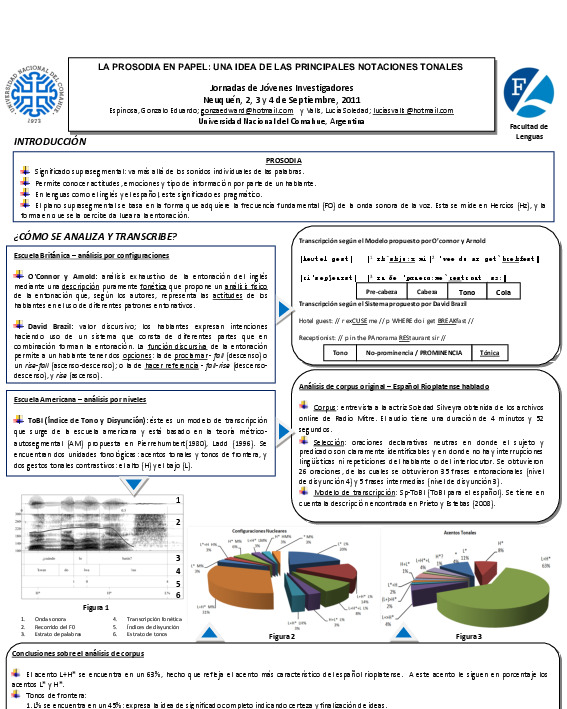
Póster presentado en las Jornadas de Jóvenes Investigadores. Neuquén, 2, 3 y 4 de Septiembre, 2011.
Position: 626 (41 views)
Tipos de verbos : en búsqueda de un aprendizaje efectivo

Tradicionalmente las clases de verbos se enseñan teniendo en cuenta sólo la facultad de seleccionar un complemento o no. Esta forma de enseñarlos enfrenta al alumno a la dificultosa tarea de tener que memorizar una extensa lista de patrones verbales. A esta dificultad se le suma la cantidad de casos que escapan a la regla general. Este aprendizaje memorístico se caracteriza por ser automático y poco sistematizado. A modo de ejemplo Hornby (1985) en Guide to Patterns and Usage in English enumera subgrupos de verbos transitivos seguidos de frase sustantiva, frase preposicional, oración finita o no finita, y sus posibles combinaciones en un listado. Este listado no siempre le permite al alumno entender porqué un verbo transitivo selecciona un determinado tipo de complemento y no otro.
(1) They did [very little work].
(2) The success of the picnic will depend [on the weather].
(3) She enjoys [playing tennis].
(4) She couldn’t decide [what to do next].
Los profesores de gramática enfrentamos el desafío de tener que sistematizar - de manera económica y práctica - clasificaciones verbales del tipo presentado anteriormente. Un posible camino a seguir es presentar en primer lugar los verbos según su carga semántica, es decir un verbo pleno describe un evento, ya sea una actividad, un proceso o un estado (adaptación de la clasificación de Vendler, 1957). Para expresar un evento y de acuerdo con la Teoría Temática (Chomsky, 1981, 1986a, 1986b, Chomsky y Lasnik 1991), un verbo selecciona un determinado número y tipo de participante o argumento. De este modo, la enseñanza de los verbos teniendo en cuenta la carga semántica y el número de argumentos que estos seleccionan reduce la clasificación a dos grandes tipos: transtitivos e intransitivos.
Position: 74 (145 views)
Más allá del aula

Introducción
Al diseñar un curso de español como lengua extranjera, el profesor debe considerar qué implica conocer una L2. Diferentes teorías sostienen que aprender una nueva lengua no es solo alcanzar un dominio funcional de un nuevo código lingüístico, sino también ser capaz de interpretar y relacionarse con una realidad sociocultural diferente. (GarcíaSanta 1996 citada en Tudela 2006). Es decir; para que el aprendiz pueda desarrollar la competencia comunicativa, la enseñanza de una lengua extranjera no puede limitarse a la enseñanza de estructuras gramaticales aisladas ya que éstas constituyen sólo un componente de la misma. Desarrollar la competencia comunicativa en el alumno implica además la competencia sociolingüística, es decir, el uso de las estructuras vistas en situaciones comunicativas reales. Por todo esto, un curso de ELE debe ser el nexo, un puente entre la realidad del aula y la realidad más allá de ella.
Este objetivo se logra a través de herramientas como el material didáctico, entre otras. Todo docente sabe que no existe “el material ideal” que contemple las diversas características, intereses y necesidades de los alumnos. Al momento de dictar el curso entonces, tiene dos opciones: adaptar el material disponible en el mercado ó diseñar sus propios materiales. Esta segunda es la opción que hemos elegido para el propósito de este trabajo.
En esta ponencia describiremos el trabajo realizado para concretar la visita al Museo Patagónico de Ciencias Naturales, uno de los más importantes del país por el valor de sus muestras paleontológicas y la visita a la Primera Cooperativa Frutícola General Roca Limitada; un galpón de empaque que recibe este nombre por ser una de las primeras asociaciones cooperativas de nuestra ciudad. Elegimos estos dos destinos para el estudiante, dada la importancia de la paleontología y la fruticultura en la zona en que vivimos. Ambos representan motores de la economía regional y el turismo y sentimos
que a través de ellos podemos trascender el aula y dar a conocer nuestra cultura. Asimismo, el museo y el galpón de empaque son instituciones que forman parte del ámbito público, donde el estudiante, como miembro de la sociedad, debe contar con las herramientas comunicativas necesarias para interactuar activamente.
Position: 396 (72 views)
Acerca de los participantes en el discurso científico-técnico en inglés

El lenguaje de especialidad plantea desafíos interesantes para el docente de lenguas extranjeras con fines específicos. En este sentido, uno de los temas de análisis frecuente en la enseñanza del inglés como medio de consulta bibliográfica en el nivel universitario, es sin dudas el tratamiento de la frase nominal con premodificadores. En efecto, los nombres que designan participantes del discurso suelen aparecer acompañados no sólo por la categoría gramatical por defecto, el adjetivo, sino además, por sustantivos yuxtapuestos, incluyendo palabras derivadas en –ing, participios adjetivales y combinaciones de varios de ellos en cadenas a veces muy largas o complejas. Especialmente en el discurso científico-técnico, estas cadenas pueden ser difíciles de interpretar aún para los lectores más competentes. En esta presentación describiremos brevemente una serie de casos que nos interesa particularmente analizar a la luz de la teoría del Léxico Generativo (Pustejovsky, 1995, 2000, 2008), un modelo esencialmente composicional que creemos puede contribuir a explicar algunos de los fenómenos que vamos encontrando. Intentaremos que este pequeño trabajo sirva como disparador de un análisis que necesariamente debe ser más profundo. Asumimos que, si bien las explicaciones que logremos a partir de un modelo teórico de esta naturaleza no sean quizás de aplicación didáctica directa en nuestros cursos, sí en cambio nos ofrecen una instancia de reflexión importante para mejorar nuestros recursos didácticos en pos de una práctica docente más eficiente.
Position: 362 (75 views)
Estudio comparativo de las selecciones tonales en español e inglés : bases para una aplicación metodológica

ABSTRACT
In this work, intonation is analysed as a phenomenon at the interface between intonational phonology and pragmatics. The pragmatic analysis is carried out in the framework of the Relevance Theory (Sperber & Wilson 1995, 2004) and its application to the study of prosodic aspects (Wilson & Wharton 2006). Prosody is studied in terms of the Autosegmental and Metrical theory based on the analysis carried out by Gabriel et al. (2010) on the Spanish of Buenos Aires. In addition, intonation is conceived of as a set of procedural instructions, in the sense that it presents the listener with instructions as to how to process the information (House 2006). Tone choices are compared between Argentinean Spanish from Patagonia and the English spoken in the southeast of England, with the purpose of finding similarities and differences in the prosodic patterns (tone choices, pitch and boundary tones) present in non-conclusive declarative sentences. The differences that have been found in terms of the type and form of tonal configurations might function as the starting point to identify possible difficulties that speakers of English as a second language may encounter.
Position: 280 (84 views)
Entonación y relevancia en el discurso hablado del español rioplatense

En este trabajo, que se ubica en la interfaz entre la fonología entonativa y la pragmática, se presenta un triple contraste fonológico en la entonación del español rioplatense, y se caracteriza su aporte a la interpretación de los enunciados en el marco de la teoría de la Relevancia (sperber & Wilson 1986-1995, 1994). se propone que las configuraciones tonales nucleares funcionan como un recurso procedimental para indicar al oyente el modo más relevante de interpretar los enunciados lingüísticos, disminuyendo el esfuerzo requerido para su procesamiento.
Position: 312 (80 views)
Procedural Encoding and Tone Choice in Buenos Aires Spanish

This chapter explores some tone choices in the spontaneous speech of Buenos Aires (Argentina) Spanish and attempts to account for them in procedural terms along the lines suggested by Relevance Theory (Wilson and Wharton, 2006). In particular, it analyses stretches of discourse beyond individual tone units, and tries to show how nuclear tone and boundary tone choices and pitch range management affect the interpretation of those tone units in terms of their function in spoken discourse, and how participants in a conversation organize information to indicate dependence, continuity and discontinuity (House, 2006). More generally, it aims to show that these tone choices encode specific instructions to guide the hearer to the most relevant interpretation of discourse by reducing the processing effort necessary to achieve the desired cognitive effects, and therefore argues for a procedural account of intonation. The prosodic analysis is carried out in the Autosegmental-Metrical framework (Pierrehumbert, 1980; Ladd, 1996) using its application to the study of Spanish intonation known as the Tone and Break Indices (Sp-ToBI) transcription system (Beckman et al., 2002; Hualde, 2003; Sosa, 2003; Estebas-Villaplana and Prieto, 2008), also used specifically in the study of Buenos Aires Spanish (Gabriel et al., 2010a). The results of the analysis suggest that relevance is pursued both at a local and at a global level, and they lend support to a compositional approach to intonational meaning, in which different prosodic choices and their combinations guide pragmatic interpretation at different levels. Overall, the chapter aims to show that Relevance Theory in general, and procedural encoding in particular, offer an insightful way to deal with prosodic phenomena and their meaning.
Position: 260 (87 views)
Un universo en una partícula: la mini-ficción en inglés como disparadora de debate

La micro-ficción en inglés se presenta, en nuestro contexto universitario, como un desafío para quienes se atreven a afrontarlo, desde lo lingüístico, socio-cultural y afectivo. Este trabajo explorará el potencial de los microrrelatos como herramientas para desarrollar las habilidades orales de alumnos avanzados del Profesorado y Traductorado en Inglés, Facultad de Lenguas (UNCo). Este género supone un lector activo que aporte su propio entendimiento a la ambigüedad inherente al micro-cuento, ya que este estímulo, acotado en apariencia, es, en esencia, infinito en pluralidad de interpretaciones. Así, a partir de una mini-ficción, se obtiene una fuente ilimitada de debate que permite el abordaje de una multiplicidad de temas. En nuestra experiencia, la posibilidad de conocer y explorar otras realidades da a los estudiantes una visión panorámica que les permite valorar la diversidad cultural.
En la materia Inglés IV, se propuso a los alumnos trabajar en grupo para seleccionar un cuento corto, analizarlo y formular preguntas que generaran la discusión de los temas centrales en él. En un paso posterior, dirigieron una clase para sus compañeros en la que se debatieron las diferentes opiniones. La naturaleza de las mini-ficciones dio lugar a una riqueza de interpretaciones, fomentada por la política de flexibilidad que se condice con los objetivos de la cátedra. Esta experiencia redundó en beneficios para el grupo en su conjunto: utilizaron la lengua meta en todo momento, se enfrentaron a nuevos universos socio-culturales, y desarrollaron una actitud de tolerancia a la ambigüedad y a la diversidad de opiniones.
ABSTRACT
In our academic context, the short-short story in English presents itself as a linguistic, sociocultural and affective challenge for those brave enough to face it. This work explores the potential of this genre as a tool for the development of oral skills in English as a Foreign Language, in advanced students taking the Teacher- and Translator- Training courses at Facultad de Lenguas (UNCo). This genre demands an act ive reader that brings his own understanding of the ambiguity inherent in the text to the reading of the story. This stimulus, which may seem as small as a particle, is, in essence, infinite in the wealth of interpretations it may trigger. Thus, from a short story, we get an unlimited source of debate that gives way to the discussion of various topics. The possibility to get to know and explore other worlds gives our students a panoramic view that makes it possible for them to value cultural diversity. Students taking the English IV course in 2010 were encouraged to work in groups to select a short story, analyse it, and pose questions to generate the discussion of the main themes in the texts. At a later stage, they delivered a lesson for their classmates with a debate of students’ opinions. The nature of micro-fiction triggered a richness of interpretations, fueled by the flexibility policy that is part of the objectives of the subject. This experience was beneficial for the course as a whole: students made use the target language at all times, they faced new sociocultural universes and they developed tolerance of ambiguity and of diversity of opinion.
Position: 251 (89 views)
La voz pasiva en inglés avanzado: un estudio cualitativo en alumnos de nivel universitario

Position: 452 (67 views)
Critical thinking in a flash: a case study of an EFL university course

This paper presents the methodology used in an EFL university course within the Teacher- and Translator- training programmes at Universidad del Comahue to foster critical thinking of literary canons, themes and styles through the use of microfiction. From 2006 to 2008, on-line or printed micro-tales were used to prompt English V learners to experience the thrills of this singular literary genre and to reflect upon the impact it may have on their beliefs about literature, on their outlook on life and on the perceptions they have of their own selves. The “adventure”, whose aim was to give lear ners brief and authentic, un-reviewed raw material to be evaluated by them in the format of reviews, ended up providing both teachers and students with the chance to explore an array of contentious issues stemming from fragments of characters‟ lives. Each piece of microfiction meant a whole different story to each learner, and, therefore, yet another challenge to face in the course. Plunging into the genre implied the revision of the canons of what literature is supposed to be like, their beliefs of what a story is thought to present, and their expectations as to what the reader‟s task comprises. With each new narrative, highly controversial topics were raised, innovative perspectives on narrating were presented and multiple versions of the story were offered.
Position: 305 (81 views)
Por qué "Nuestro viaje con María" sí, pero "Nuestro kajak con Andrea" no

(1) a. Nuestra fiesta con María fue todo un éxito.
b. Nuestra presentación con Andrea convenció a todos.
c. Nuestro artículo con María sobre las nominalizaciones vio finalmente la luz.
d. *Nuestro kayak con Andrea se hundió.
e. *Nuestro hermano con Marquitos está en Australia.
f. *Nuestra conexión a internet con María está funcionando muy mal.
En esta presentación nos proponemos discutir los datos de (1) desde la perspectiva de la Morfología Distribuida (Halle & Marantz 1993).
Objetivo
Determinar los rasgos que legitiman la presencia de un sintagma comitativo en el ámbito nominal y cuál es su posición en la estructura del SD en (1a-c).
Hipótesis
El sintagma comitativo solo puede aparecer en el ámbito nominal, si en la estructura del SD hay algún argumento asociado con determinados papeles temáticos. Dichos papeles temáticos son los mismos que puede tener el comitativo concordado en el ámbito verbal.
Para alcanzar nuestro objetivo discutimos, por un lado, la estructura del SD en cuanto a las proyecciones funcionales presentes en ella (Ticio 2003) y, por el otro, las características de los nombres involucrados a partir del análisis de los rasgos del categorizador n° (Picallo 1999, Alexiadou 2001, Resnik 2010).
Position: 296 (82 views)
Actas del V Encuentro de Gramática Generativa
Actas del V Encuentro de Gramática Generativa (EncuentroGG) desarrollado del 28 al 30 de julio de 2008 en la Ciudad de General Roca, Río Negro, Argentina.
Organizadas por la Maestría en Lingüística de la Facultad de Lenguas de la Universidad Nacional del Comahue.
Comité académico:
Ángela Di Tullio (Universidad Nacional del Comahue)
David Embick (University of Pennsylvania)
Jairno Nunes(Universidades de Sao Paulo)
Mary Kato (Universidade Estadual de Campinas)
Francisco Ordoñez (Stony Brooks University)
Marta Luján (University of Texas)
Comité organizador:
Adriana Álvarez (U.N. Del Comahue)
Alicia Avellana (Universidad De Buenos Aires/Conicet)
Lucía Brandani (Universidad De Buenos Aires/ U.N. De General Sarmiento)
Ángela Di Tullio (U.N. Del Comahue)
Laura Kornfeld (Universidad De Buenos Aires/ U.N. De General Sarmiento/Conicet)
María Mare (U. N. Del Comahue/ Conicet)
Mercedes Pujalte (U. N. Del Comahue/ Conicet)
Gabriela Resnik (U.N. De General Sarmiento)
Andrés Saab (U.N. Del Comahue)
Pablo Zdrojewski (U.N. Del Comahue/ Conicet)
Position: 576 (50 views)