
Navegar por los elementos
Póster del Proyecto J033 en Jornadas de Difusión de Investigación y Extensión del DIEPE

Position: 368 (44 views)
Enseñanza y aprendizaje de secuencias formulaicas en estudiantes de ILE (inglés como Lengua Extranjera) en escuelas primarias

Position: 474 (35 views)
¿Y el viento las amontona?: Un nuevo enfoque en la enseñanza del vocabulario de las lenguas extranjeras

Position: 281 (50 views)
Peeping into myths and legends for chunks: an exploratory study

New perspectives on vocabulary learning and teaching have led linguists, such as Sinclair (1991), Lewis (1993, 1997 & 2000), Hoey (2005), Meunier & Granger (2008) and Schmitt (2010), among others, to redefine the Lexicon by claiming that this inventory is not only made up of morphemes and words but also formulaic sequences. Precisely, a single instance of this recurrent language phenomenon is defined as, “a sequence continuous or discontinuous, of words” [...] “which is, or appears to be prefabricated: that is, stored and retrieved whole from memory at the time of use, rather than being subject to generation or analysis by the language grammar" (Wray 2002: 9).
In this exploratory study, we set out to investigate the recurrence of FSs in unabridged versions of myths and legends from different parts of the world in English. We report on a number of steps that were followed in order to build a small corpus of FSs which are inherent in these narrative text types. A subsequent selection of those strings of words which are both frequently used and pedagogically relevant for ESL primary school students from this corpus will lead to the design of teaching material for this group of young learners.
Position: 224 (57 views)
Formulaic sequence acquisition : from research to praxis

Research into different multiword phrases has shed light on the need to devote teaching time to these sequences in foreign language classrooms. A shift away from the individual word to, among others, the formulaic sequence (FS), defined by Wray (2002) as “a sequence, continuous or discontinuous, of words or other elements, which is, or appears to be, prefabricated: that is, stored and retrieved whole from memory at the time of use, rather than being subject to generation or analysis by the language grammar” (p. 9), has led to studies which analyse the effects of explicit instruction of FSs in different educational contexts and levels of proficiency in the foreign language. There is by now sufficient evidence (Ab Manan et al. 2014a and b; Alhassan and Wood 2015; Boers and Lindstromberg 2012; Čolović-Marković 2012; Jones and Haywood 2004; Lewis 2009; Peters and Pauwels 2015 and Wood 2015) that advocates the teaching of formulaic sequences in EFL contexts. One such study carried out in an Argentinean university with Spanish-speaking learners of English of different proficiency levels has highlighted the implications of a number of relevant issues in connection with the learning and, consequently, the teaching of vocabulary in general to learners of different levels and in multiple learning contexts. The findings refer to a) three explicit, focus-on-form FS instruction experiments (with beginner level and advanced level students), b) a small-corpus study into FS implicit learning in a content-based course, c) a longitudinal case study of one learner’s formulaic competence across his written production in an academic year and d) the acquisition of song-derived FSs by senior adults taking a reading comprehension course at university.
The data obtained point to learners’ heightened awareness of the patterns of use and meanings of the selected FSs as a result of pedagogical intervention. Significant benefits of FS teaching have been found for FS retrieval and acquisition in controlled conditions and free contexts. There is little evidence of incidental intake of FSs present in the reading material by learners, which shows that attention needs to be explicitly drawn to their existence, pervasiveness, use, form and meanings. The longitudinal case study reveals a systematic and conscious approach to FS learning, with evidence of a continuously recycled and intentionally refurbished process of FS acquisition. FS recognition and comprehension has been proved to improve in time through a FS-focused approach and even elderly participants evince an important degree of sensitivity to the internal make-up of FSs.
The different sets of data attest to the benefits of FS explicitly instruction in a foreign language as a means of equipping learners with prefabricated units of meaning to perform more naturally in the L2. Practical tips on FS teaching for the FL classroom are offered in relation to the nature of the sequences to teach and of the pedagogical intervention planned, the number of hours devoted to instruction, and activity types both for the teaching and practice of these chunks and for testing purposes.
Position: 341 (46 views)
Thinking outside the word : contributing to the teaching of vocabulary in public schools

This presentation describes the objectives of the research project and the different activities completed: the teacher-training courses taught, and the materials designed for a pilot experience in 2020 to teach formulaic sequences in songs and legends in primary schools. It will outline future courses of action and the importance of establishing links among university, research findings and the EFL teaching community.
Position: 368 (44 views)
Chunky chunks : A formulaic approach to teaching vocabulary

Position: 217 (58 views)
Let’s teach vocabulary through legendary lessons

Position: 114 (79 views)
This is the story of… : legends in the acquisition of formulaic sequence in adult secondary schools

Our experience with the use of legends of native people in the English class confirms that not only intercultural competence can be developed, but also chronological-temporal discursive formulaic sequences can be acquired in relation to the chronological organization of events. We describe the experience carried out at two evening schools and its impact on the writing of novel legends.
Position: 305 (48 views)
Formar para enseñar : de palabras sueltas a lenguaje formulaico

Los descubrimientos de la lingüística de corpus han gestado una visión del léxico como algo más que un conjunto de ítems aislados (Sinclair,1991; Lewis, 1993, 1997 y 2000; y Schmitt, 2010). En este sentido, Wray (2002) define como secuencias formulaicas (SFs) a “una secuencia, continua o discontinua, de palabras […] almacenada y recuperada de la memoria como una unidad en el momento de uso, no sujeta a generación o análisis de la gramática del lenguaje” (p. 9). Estudios confirman la ubicuidad de estas frases típicas que comparten un significado universal para una comunidad de hablantes. Para los estudiantes de una lengua extranjera, la percepción holística de estas secuencias y la imprimación conjunta de su forma, uso y significado puede resultar un desafío (MacKenzie y Kayman, 2016). Suscribiendo a Boers y Lindstromberg (2009; 2012), Granger (2015), Granger y Meunier (2008), Wood (2010) y Wray (2008) consideramos necesario que estudiantes de ILE de FadeL, reconozcan y empleen SFs productiva y eficazmente. A tal fin, investigamos la instrucción explícita y el aprendizaje de dichas secuencias en talleres UPAMI, ILI, LI1, LI31 y Didáctica Especial y Residencia y diseñamos cursos de transferencia para docentes de escuelas primarias y secundarias de nuestra provincia. Estas experiencias orientaron la intervención pedagógica en escuelas primarias (PIN J033) que se ha comenzado a implementar a través de dos ciclos de formación para docentes (2019) y del diseño y publicación de materiales didácticos específicos, retroalimentando nuestra práctica docente como formadores de futuros profesionales de ILE en nuestra facultad.
Position: 57 (123 views)
El dictogloss : una herramienta pedagógica que fomenta el uso productivo de vocabulario en una lengua extranjera

Position: 10 (641 views)
Dictogloss steals the show? Productive use of formulaic sequences by advanced learners

Corpus studies into the nature of language and the interrelationship between grammar and lexis have highlighted the pervasiveness of recurrent strings of words essential to the construction of meaning which Wray [2002: 9] has named “formulaic sequences” (FS). Research by Boers et al [2006], Eyckmans [2007], Stengers [2009] and Wray & Fitzpatrick [2008] suggests that good command of these phrases in the foreign language (FL), of their typical occurrence and of their use restrictions contributes to learners’ fluency, and is taken as evidence of a high level of proficiency. Boers & Lindstromberg [2012] argue that explicit FS instruction accompanied by awareness-raising tasks yield significant learning gains, especially in FL contexts. As a pushed-output procedure, Wajnryb’s dictogloss technique [1990] has recently been adapted in FS-focused instruction studies like those of Janssens [2016] and Lindstromberg, Eyckmans & Connabeer [2016]. In similar fashion, we designed an experimental study for the teaching of nine pedagogically relevant sequences with Spanish-L1 EFL university learners. Two types of treatment were implemented with a focus on the target FSs’ meanings, forms and uses with two naturally-occurring learner groups (Group 1, N=13, and Group 2, N=17), whose performance was compared to that of a control group (N=7). Group 1 completed a set of Focus-on-Form activities [Doughty & Williams 1998], while Group 2 carried out two sessions of FS-oriented dictogloss. Results show that learners in Group 2 produced 40 instances of the target FS in five essay-writing tasks at different stages of the study and as late as a month and a half post intervention. By contrast, Group 1 produced 23 instances of seven target FSs across three essay writing tasks, six weeks after treatment. These findings indicate that dictogloss seems to reinforce advanced students’ familiarization with target FS in context, and FS memory retention over time. Based on the descriptive analysis of uncued target FSs produced by learners in their written production tasks, the possible contributions of dictogloss to long-term FS acquisition are discussed.
Position: 271 (51 views)
Una perspectiva formulaica en la enseñanza de vocabulario de una lengua extranjera

Décadas de estudios de corpus sobre el uso del lenguaje confirman que el lenguaje se compone en gran medida de lenguaje prefabricado o formulaico (Erman y Warren, 2000), es decir, de combinaciones de frases que se emplean para transmitir un mismo mensaje denominadas ‘secuencias formulaicas’ (SSFF) (Wray, 2002) que cumplen diversas funciones comunicativas en un idioma. Esta visión del léxico en general señala que la enseñanza del vocabulario en una L2 (extranjera o segunda) debe focalizarse no ya en ítems léxicos individuales sino en estas secuencias frecuentes. Surge así una nueva pedagogía necesaria para contribuir a la percepción en el input de estas cadenas de palabras por parte de los aprendientes y fomentar su práctica y uso cotidiano. Boers y Lindstromberg (2012) resumen numerosas investigaciones que demuestran el mayor impacto de la instrucción explícita de SSFF en la adquisición de estas unidades de significado por sobre un abordaje implícito. Estudios experimentales como Fernández y Valcarce (2017) y Zinkgraf y Verdú (2017) señalan los beneficios de la metodología de enfoque en la forma a la enseñanza de SSFF en futuros docentes de inglés como lengua extranjera en su reconocimiento y en producción guiada y espontánea. Este trabajo describe una propuesta de enseñanza explícita de vocabulario basada en secuencias formulaicas y presenta los objetivos y procedimientos para explorar la adquisición de SSFF de canciones y leyendas en estudiantes de inglés de escuelas de nivel primario en Argentina. Se discuten los fundamentos teóricos que subyacen el diseño de materiales para esta experiencia piloto.
Abstract
More than three decades of studies in corpus linguistics confirm that language use is composed to a great extent of prefabricated or formulaic language (Erman & Warren 2000), that is, of combinations of phrases used to convey the same message. These phrases, called ‘formulaic sequences’ (FSs) by Wray (2002) recurrently fulfill a set of communicative functions in language. This shifting perspective of the lexicon in general suggests that the teaching of a foreign (or second) language needs to focus not on individual lexical items but on these frequent sequences. A new approach is necessary to contribute to learners’ noticing of these strings of words in the input to later encourage their practice and use. Boers & Lindstromberg (2012) summarise several investigations that prove the significant impact of the explicit teaching of these units of meaning on FS acquisition over more implicit methodologies. Experimental studies like Fernández & Valcarce (2017) and Zinkgraf & Verdú (2017) point to the advantages of a Focus on Form approach to the teaching of FSs with respect to recognition and controlled and spontaneous production in groups of EFL teachers-to-be. This paper presents the objectives and procedures to explore the acquisition of FSs found in songs and legends by younger primary-school learners of English while describing the underlying principles of the pedagogical materials designed for that research experience.
Position: 125 (77 views)
Assessing in-service training on teaching and learning formulaic sequences

This presentation describes an in-service training course offered to EFL teachers in primary and secondary schools on the teaching and learning of formulaic sequences (Wray, 2002) and its evaluation process. Whereas the formative assessment of participants’ intake of the course’s contents pointed to the successful incorporation of concepts and pedagogical proposals, the analysis of participants’ practical assignments (formal sum ative assessment) underlined some difficulties as to the implementation of these contents in the tasks.
Summary
In-service training contributes to graduated teachers’ further development in aspects related to their everyday practice. This presentation describes the formative and summative assessment (Brown, 2004) in a free yearly course taught by research team J033 at Comahue University during 2019 for primary- and secondary-school teachers of English. The course aimed to equip participants with theoretical-practical knowledge on how to teach contextualised formulaic sequences (Wray, 2002) (FSs) through authentic songs, legends and myths, and motivate them to engage in a future pilot experience teaching formulaic language in their own EFL settings. Eleven school teachers from Río Negro and Neuquén participated in the two-module course consisting of 70 hours’ work in meetings and online participation through the university’s Moodle platform. As instances of formative assessment (Brown, 2004), group discussions in class and through virtual forums engaged teachers in the discussion of key concepts in the bibliography on FS instruction. Participants also delivered oral presentations of tasks designed for the introduction of FSs.
The formal summative assessment of this course consisted of two real-life tasks involving the implementation of central contents of the course: a) designing classroom activities to teach pre-selected formulaic sequences in their contexts and b) teaching a simulated lesson on FSs as outlined in the corresponding lesson plan. These tasks provided an insight into teachers’ grasp of the underlying principles of FS teaching (Lindstromberg and Boers, 2008) and of their application in EFL classrooms and, by extension, into the extent to which the workshops’ objectives may have been accomplished.
The analysis of the practical assignments submitted pointed to some difficulties participants encountered in complying with the tasks. Summarising the theory to justify decisions on the sequences to teach and relating this to the aims of the tasks designed were frequently found obstacles. Constructive feedback and a process-oriented approach in subsequent resubmissions contributed to a profitable evaluation process.
Position: 257 (53 views)
Testing the waters: assessing formulaic-sequence acquisition in primary school learners

This presentation discusses the principles underlying a battery of tests designed to measure the acquisition of vocabulary in terms of formulaic sequences (FSs) in EFL primary school children participating in an explicit instruction research experience (Wray, 2002). Examples of different testing activity types to measure both receptive and productive knowledge of FSs are analysed in relation to noticing, retrieval and generative use in test development with implications for both EFL teaching and research.
Summary
Formulaic sequences (FSs) are frequently encountered strings of words that typically convey specific meanings and functions and are retrieved as wholes by native speakers of a language (Wray, 2002). Research into foreign language teaching (Boers & Lindstromberg, 2012; Wood, 2015) nowadays advocates FS-focused instruction in the classroom, optimizing learners’ FL acquisition through detection, retrieval and creative use (Lindstromberg & Boers, 2008; Pellicer-Sánchez & Boers, 2019).
Our research project analyzes the effect of teaching FSs in songs and legends to EFL public primary school students with an A1 proficiency level (CEFR) and assesses FS acquisition through a battery of tests designed to measure both receptive and productive knowledge of the target sequences (Gyllstad & Schmitt, 2019). Test results serve a two-fold purpose in the teaching and the research domains: to assess the learning of FSs in children with nearly no prior EFL instruction - and none in terms of formulaic language- and to gauge the effects of an explicit, focus-on form pedagogical intervention on their learning through different task-types assessing to what degree the target sequences are recognised and/or used productively over an extended period of time (nine to ten months).
This presentation will analyse examples of different testing activity types in relation to noticing, retrieval and generative use (Lindstromberg & Boers, 2008) and the principles in test development (Hughes, 1996; Read & Nation, 2004; Lewis, 2009) to show how language research and teaching are intrinsically conjoined. This research will provide applied linguists and teachers with information on learners’ vocabulary intake at different stages, and offer insights into participants’ formulaic competence development which can feed back into the EFL classroom.
Position: 281 (50 views)
In-service training on teaching and learning formulaic sequences and its assessment

This paper describes a free yearly course taught by research team J033 at Comahue University during 2019 for primary- and secondary-school teachers of English and some insights gained through its formative and summative assessment (Brown, 2004). The course aimed to equip participants with theoretical-practical knowledge on how to teach contextualised formulaic sequences (Wray, 2002) (FSs) through authentic songs, legends and myths, and motivate them to engage in a future pilot experience teaching formulaic language in their own EFL settings.
The paper first discusses some theoretical issues related to formulaic sequences and their teaching in EFL contexts. Then it describes the course in terms of its aims and content, while also considering the different tasks completed by participants for formative and summative assessment. As instances of formative assessment (Brown, 2004), there were face-to-face and virtual group discussions in which teachers discussed key concepts in the bibliography on FS instruction, and oral presentations in which participants described sets of tasks designed for the introduction of FSs in their teaching contexts. Formal summative assessment consisted of three real-life tasks involving the implementation of central content in the course, which were meant to provide an insight into teachers’ grasp of the underlying principles of FS teaching (Lindstromberg & Boers, 2008) and their application in EFL classrooms and, by extension, into the extent to which the workshops’ objectives may have been accomplished.
The paper analyses some common features in the practical assignments submitted by participants for the assessment of the course. Tasks like summarising the theory to justify decisions on the sequences to teach and relating this to the aims of the tasks they designed posed some challenges to trainees. These challenges are examined and some implications are also discussed in terms of teaching FSs in in-service teachers’ contexts.
Position: 234 (56 views)
From the drums of ancestors’ tales to the pop tunes of today: Teaching formulaic sequences with legends and songs
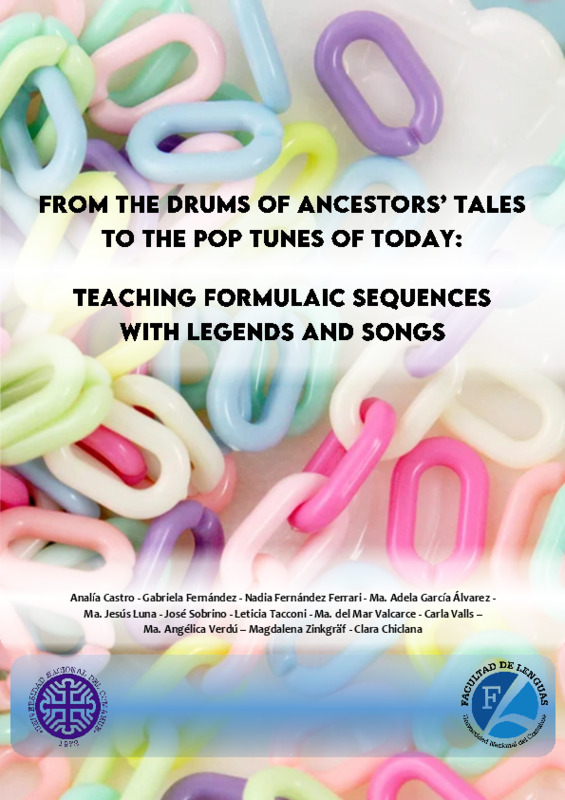
En el libro convergen los conocimientos recogidos de las lecturas y estudios de dos proyectos de investigación (J023 de 2013 a 2017 y J033 de 2018 a 2022) que se llevaron a cabo en la Facultad de Lenguas, Universidad Nacional del Comahue así como de la práctica docente especializada por parte de los integrantes del equipo de investigación. Este libro se compone de tres partes: una sección destinada a los lectores donde se ofrece una guía al libro. La segunda sección se ocupa de los lineamientos teóricos de adquisición de vocabulario en lengua extranjera sobre los que se apoya este abordaje formulaico, su aplicación y efectividad. Además, se esbozan principios orientadores para docentes de inglés de la comunidad sobre el manejo del material didáctico para lograr resultados eficaces en la adquisición de secuencias formulaicas por parte de sus estudiantes. La tercera parte, que se destina a las prácticas áulicas, consta de seis capítulos que ofrecen una compilación de planes de trabajo basados en la enseñanza y aprendizaje de diferentes grupos de secuencias formulaicas extraídas de tres leyendas y tres canciones canciones auténticas y contemporáneas y leyendas en inglés alternadas. Están orientadas a estudiantes de inglés como lengua extranjera en escuelas primarias con un nivel elemental de proficiencia lingüística en inglés. Cada unidad didáctica cuenta con una guía de trabajo para los y las estudiantes con actividades de repaso e integradoras de las secuencias formulaicas trabajadas en cada unidad didáctica con ilustraciones originales en color. Está acompañada de guías didácticas con pasos detallados para los docentes que deseen implementarlas en sus aulas y en algunos casos actividades adicionales.
El libro cuenta con archivos multimedia para las actividades.
Position: 27 (273 views)
Reflexiones sobre una experiencia de enseñanza explícita de secuencias formulaicas en el nivel primario en el contexto de ILE

El objetivo de este trabajo es realizar un análisis preliminar de las percepciones registradas en las bitácoras de una docente de inglés a cargo de dos grupos de 12 y 18 estudiantes respectivamente, de nivel de proficiencia elemental (MCER), de una escuela estatal primaria de la provincia de Río Negro, sobre una propuesta didáctica basada en una canción y una leyenda en inglés para la enseñanza explícita de 13 SSFF. La docente utilizó dos bitácoras, una para cada grupo, que completó durante el ciclo lectivo 2023 e informó a través de un audio o mensaje de Whatsapp. Para cada una de estas entradas, se le propuso a la docente reflexionar sobre el funcionamiento de la propuesta didáctica, la reacción de sus estudiantes y la identificación de dificultades además de la explicitación de las tareas completadas hasta ese momento. En total, se documentaron 12 entradas para cada grupo, las cuales fueron utilizadas para rastrear y examinar sus apreciaciones en relación al efecto general de la propuesta diseñada y desprender información valiosa para el diseño de posibles secuencias didácticas para la enseñanza de SFs para aprendices de ILE o cualquier otra lengua del nivel primario.
Position: 584 (16 views)
Cantando al ritmo de los grandes para adquirir vocabulario y desarrollar estrategias de lectura

Position: 305 (48 views)
Many moons ago… : secuencias formulaicas en leyendas en Nivel Medio

Position: 368 (44 views)