comprensión lectora
Estudio léxico de las colocaciones verbo + nombre y su vinculación con la enseñanza de una lengua extranjera

El aprendizaje del vocabulario es un desafío para los aprendientes de una lengua extranjera, particularmente reconocer y comprender colocaciones léxicas en el discurso académico. El objetivo de este estudio es analizar la comprensión de colocaciones verbo + nombre en textos académicos en inglés por estudiantes que cursan un idioma extranjero en la Universidad del Comahue. Se administró una prueba de elección múltiple a sesenta estudiantes, que consistió en el reconocimiento de treinta y seis colocaciones en tres grupos de doce colocaciones, cada uno con prosodia neutra, positiva o negativa. Una entrevista semiestructurada dio mayor información de quince sujetos seleccionados al azar. Un número significativo de estudiantes tuvo dificultad al reconocer las colocaciones en contexto. En la entrevista, el nivel de comprensión fue mayor. No hay evidencia suficiente de incidencia del tipo de prosodia en el reconocimiento de las colocaciones.
Position: 280 (57 views)
Reading Comprehension and Writing in English for Translation Purposes (ETP)

Teaching English to translation trainees can be seen to have a specific purpose. The term English for Translation Purposes (ETP) has been coined to refer to a teaching method that straddles between the acquisition of English as Language B and the learning of cognitive, metacognitive, instrumental and strategic knowledge related to the task of translating. In other words, ETP combines the development of students’ communicative competence in English and Translation Competence (TC), so that they can carry out linguistic, pragmatic and cultural analyses in order to effectively comprehend, produce and translate texts.
I teach Lengua Inglesa Aplicada a la Traducción III (C1, CEFR), which is the fourth English language subject of a five-year program, and the second of three ETP subjects. The ETP courses focus on training students to acquire the necessary competences for the comprehension of a source text in English of any field; and the construction of coherent and effective texts in English for inverse translation commissions. The main macroskills focused are, thus, Reading Comprehension (RC) and Writing (Wr). Tasks prepare students to discuss and solve text-construction problems in the source and target languages, which entails knowledge of the linguistic elements involved and a command of the cultural specificities of the source and target communities (Clouet, 2010).
In their review of TC and its subcompetences, Hurtado Albir et al. (2022) conclude that, in order to improve TC acquisition, the teaching learning process should, among other priorities:
-
focus more on translation problems related to the writer/speaker’s intention,
-
develop the strategic subcompetence,
-
develop the writing skill and
-
encourage greater use of cognitive resources.
Hatim and Munday (2004) adhere to Nida’s dynamic approach to equivalence and find it useful to take into account the extra-linguistic elements involved in the decision-making process entailed by translation: “Through dynamic equivalence, we can thus cater for a rich variety of contextual values and effects which utterances carry within texts and which a literal translation would simply compromise.” (42-43).
Along these lines, RC and Wr tasks are divided into three stages: comprehension, appreciation and production. Comprehension tasks usually involve summary writing. Appreciation tasks focus on the rhetorical and discursive features of the text (such as source, purpose, target audience and intended reaction, register, tone and strength of claim) and the identification, discussion and suggested solution to potential translation problems. The production stage involves drafting a new text in response to the given one, or triggered by some of the issues dealt with in it.
This workshop will be divided into two parts. In the first one, the rationale behind the design of Reading Comprehension and Writing activities in an ETP course will be discussed briefly. In the second part, a sample RC/Wr task will be shared and analysed in terms of contents, organisation and aims. Then, participants will be encouraged to discuss the advantages and potential drawbacks of using this kind of activity in their teaching-learning contexts and will be asked to adapt it accordingly.
Position: 486 (39 views)
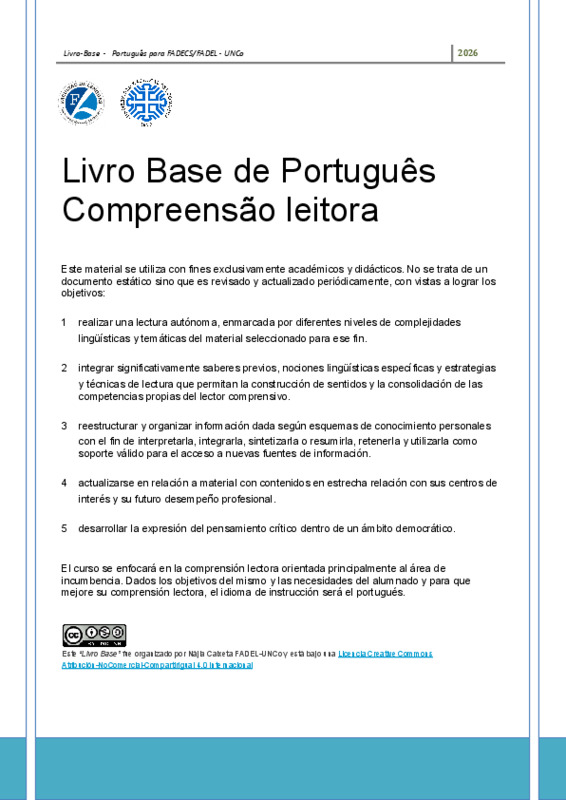
Livro Base de Português Compreensão leitora
Position: 433 (44 views)