
Navegar por los elementos
Ordenar por:
póster
Close Composting Cycle
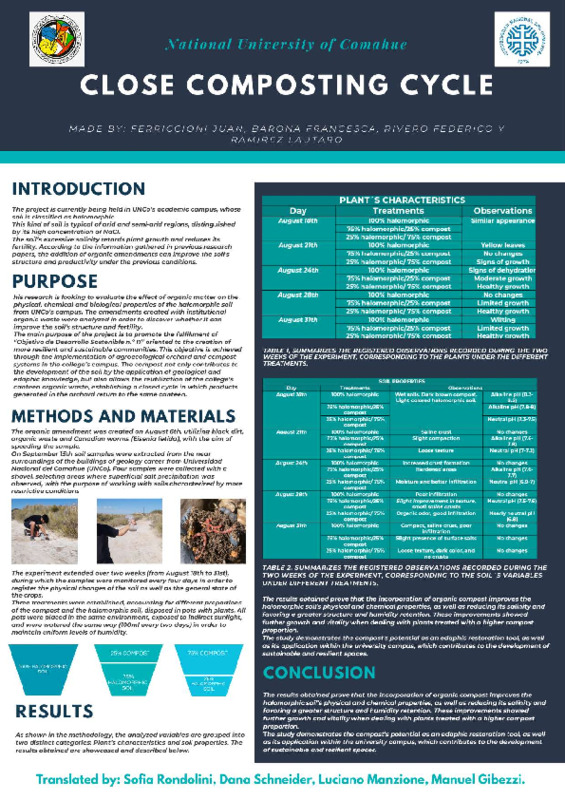
Soil degradation due to salinity and sodicity represents a global issue that limits agricultural productivity and environmental sustainability. In this context, organic amendments such as compost offer a sustainable alternative for the restoration of halomorphic soils. This study was conducted on the university campus of the National University of Comahue, where the effect of organic compost on soil physical and chemical properties and plant growth was evaluated. An amendment composed of black soil, organic waste, and earthworms was prepared, and three treatments with different compost and halomorphic soil proportions were applied over two weeks, recording soil and plant variables every four days. The results showed that increasing compost proportions reduced salinity, improved soil structure and moisture retention, and promoted more vigorous plant growth. It is concluded that compost represents an effective tool for improving soil quality, promoting sustainable management practices, and reusing institutional organic waste, contributing to the achievement of Sustainable Development Goal No. 11 and strengthening environmental education within the university environment.
Leer más...Position: 557 (19 views)
informe de investigación
Closed Composting Cycle in Halomorphic Soils of the UNCo University Campus
Soil degradation due to salinity and sodicity represents a global issue that limits agricultural productivity and environmental sustainability. In this context, organic amendments such as compost offer a sustainable alternative for the restoration of halomorphic soils. This study was conducted on the university campus of the National University of Comahue, where the effect of organic compost on soil physical and chemical properties and plant growth was evaluated. An amendment composed of black soil, organic waste, and earthworms was prepared, and three treatments with different compost and halomorphic soil proportions were applied over two weeks, recording soil and plant variables every four days. The results showed that increasing compost proportions reduced salinity, improved soil structure and moisture retention, and promoted more vigorous plant growth. It is concluded that compost represents an effective tool for improving soil quality, promoting sustainable management practices, and reusing institutional organic waste, contributing to the achievement of Sustainable Development Goal No. 11 and strengthening environmental education within the university environment.
Leer más...Position: 575 (17 views)
informe de investigación
Information and awareness campaign on energy efficiency at FaEA
The purpose of this work is to promote awareness and knowledge about energy efficiency among students of the Faculty of Economics and Administration (FaEA) of the National University of Comahue. Based on an informative campaign on social media, complemented with surveys and a focus group, the aim was to gather perceptions, habits, and knowledge levels related to responsible energy use within the university environment. The results showed that, although there is the practice of certain saving behaviors—such as maximizing natural light or turning off unnecessary lights—a limited understanding of energy efficiency and its environmental impact persists. Solar energy was identified as the most viable renewable alternative for the institution, both for its technical feasibility and its educational value. Although low participation restricted the quantitative scope of the study, the qualitative analysis allowed for the recognition of an incipient environmental awareness and a growing interest in sustainability. It is concluded that it is necessary to strengthen university energy education through comprehensive strategies that articulate communication, training, and institutional management, in line with Sustainable Development Goal No. 7: Affordable and Clean Energy.
Leer más...Position: 583 (16 views)
informe de investigación
The role of accounting as a driver of sustainability (SDG 12)
This study analyzes the implementation of sustainable practices in five households over a five-month period, focusing on three axes: waste separation, use of reusable bags, and responsible consumption. Baseline and final surveys were administered, monthly follow-ups were conducted, and an economic exercise compared the cost of “non-responsible” purchasing options versus more sustainable alternatives. Results show that four out of five families reduced their use of single-use plastic bags to near zero, decreased weekly household waste, and increased waste separation. In addition, all families recorded economic savings associated with responsible consumption: the September analysis indicates an average saving of approximately 28–30% in the categories assessed. This suggests that consumption choices aligned with SDG 12 involve not only a lower environmental impact, but also household economic efficiency. Finally, we propose that accounting can function as a pedagogical tool: quantifying waste avoided and money saved supports informed household decision-making and links day-to-day behavior with environmental and financial consequences.
Leer más...Position: 542 (22 views)
informe de investigación
Sustainable Spaces: A Perspective from the University Community
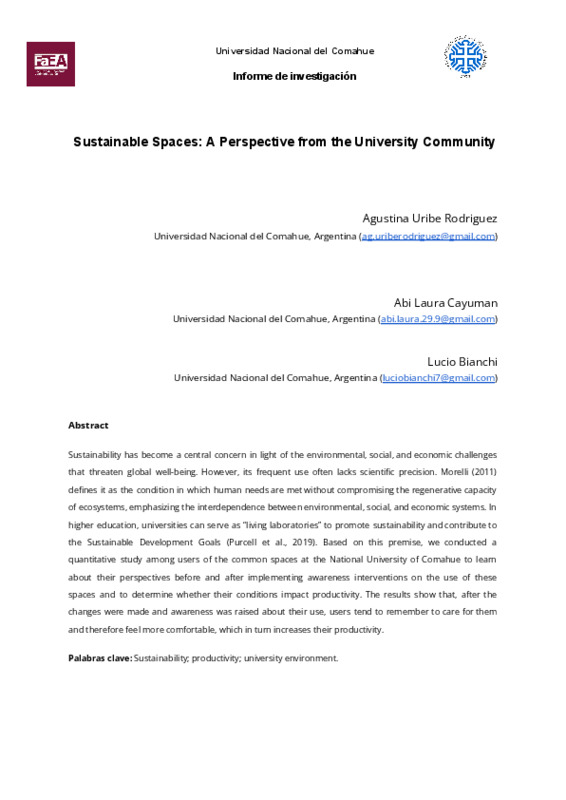
Sustainability has become a central concern in light of the environmental, social, and economic challenges that threaten global well-being. However, its frequent use often lacks scientific precision. Morelli (2011) defines it as the condition in which human needs are met without compromising the regenerative capacity of ecosystems, emphasizing the interdependence between environmental, social, and economic systems. In higher education, universities can serve as “living laboratories” to promote sustainability and contribute to the Sustainable Development Goals (Purcell et al., 2019). Based on this premise, we conducted a quantitative study among users of the common spaces at the National University of Comahue to learn about their perspectives before and after implementing awareness interventions on the use of these spaces and to determine whether their conditions impact productivity. The results show that, after the changes were made and awareness was raised about their use, users tend to remember to care for them and therefore feel more comfortable, which in turn increases their productivity.
Leer más...Position: 565 (18 views)