
compost
2 resultados encontrados
informe de investigación
Closed Composting Cycle in Halomorphic Soils of the UNCo University Campus
Autoría: Barona Müller, M. Francesca V.; Ferri, Juan; Rivero, Federico …
Año: 2025
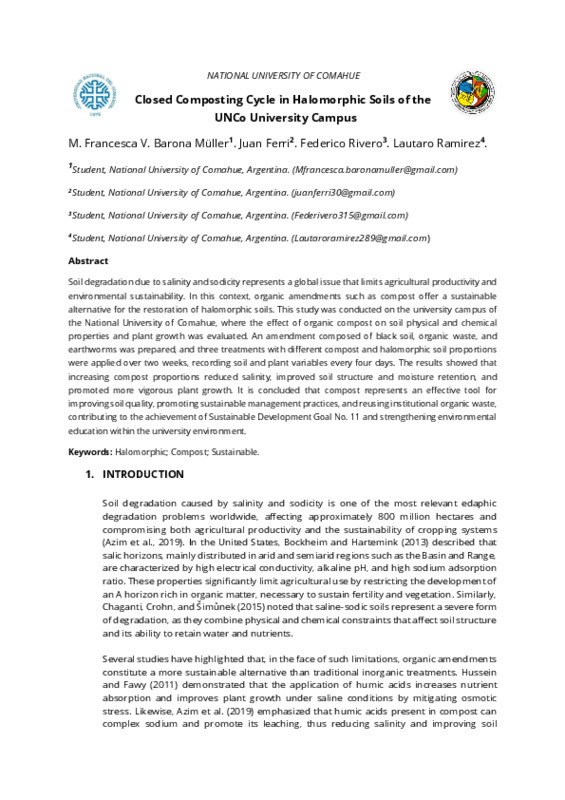
Soil degradation due to salinity and sodicity represents a global issue that limits agricultural productivity and environmental sustainability. In this context, organic amendments such as compost offer a sustainable alternative for the restoration of halomorphic soils. This study was conducted on the university campus of the National University of Comahue, where the effect of organic compost on soil physical and chemical properties and plant growth was evaluated. An amendment composed of black soil, organic waste, and earthworms was prepared, and three treatments with different compost and halomorphic soil proportions were applied over two weeks, recording soil and plant variables every four days. The results showed that increasing compost proportions reduced salinity, improved soil structure and moisture retention, and promoted more vigorous plant growth. It is concluded that compost represents an effective tool for improving soil quality, promoting sustainable management practices, and reusing institutional organic waste, contributing to the achievement of Sustainable Development Goal No. 11 and strengthening environmental education within the university environment.
Leer más...Position: 584 (20 views)
póster
Close Composting Cycle
Autoría: Barona Müller, M. Francesca V.; Ferri, Juan; Rivero, Federico …
Año: 2025
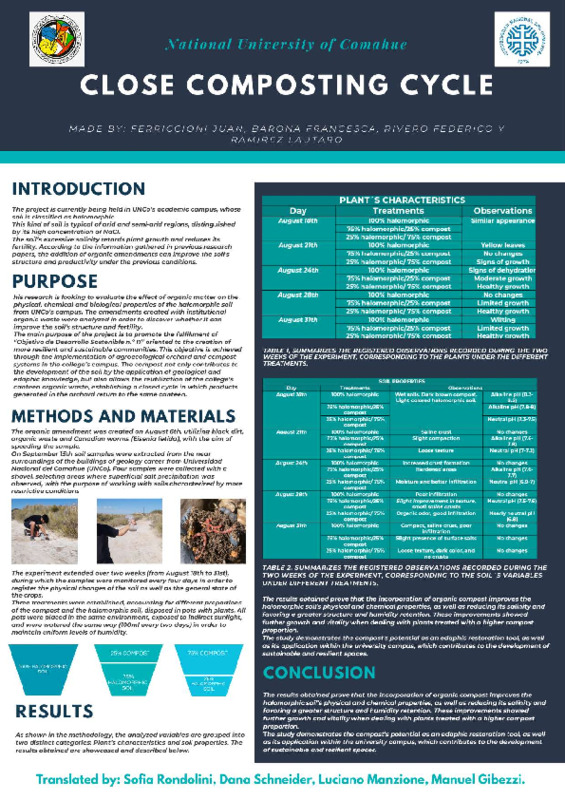
Soil degradation due to salinity and sodicity represents a global issue that limits agricultural productivity and environmental sustainability. In this context, organic amendments such as compost offer a sustainable alternative for the restoration of halomorphic soils. This study was conducted on the university campus of the National University of Comahue, where the effect of organic compost on soil physical and chemical properties and plant growth was evaluated. An amendment composed of black soil, organic waste, and earthworms was prepared, and three treatments with different compost and halomorphic soil proportions were applied over two weeks, recording soil and plant variables every four days. The results showed that increasing compost proportions reduced salinity, improved soil structure and moisture retention, and promoted more vigorous plant growth. It is concluded that compost represents an effective tool for improving soil quality, promoting sustainable management practices, and reusing institutional organic waste, contributing to the achievement of Sustainable Development Goal No. 11 and strengthening environmental education within the university environment.
Leer más...Position: 569 (22 views)