Financial Education Program for University Students
Archivos
Resumen
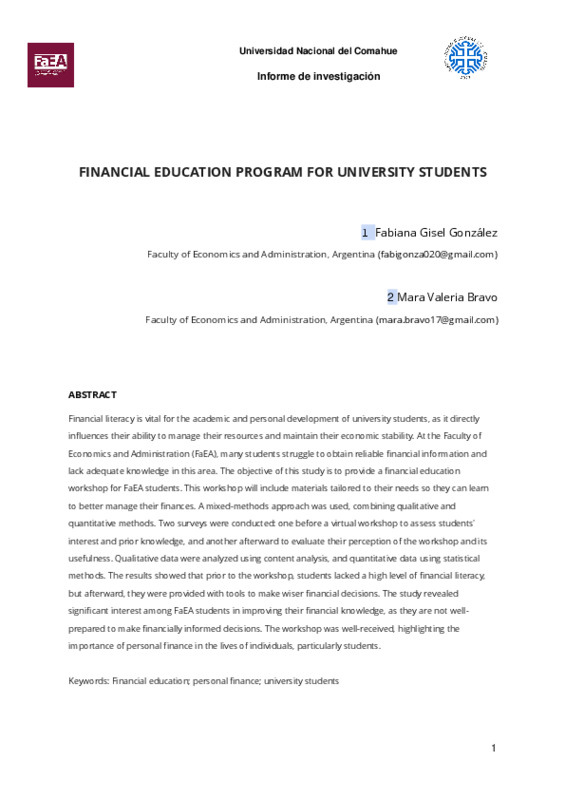
Financial literacy is vital for the academic and personal development of university students, as it directly influences their ability to manage their resources and maintain their economic stability. At the Faculty of Economics and Administration (FaEA), many students struggle to obtain reliable financial information and lack adequate knowledge in this area. The objective of this study is to provide a financial education workshop for FaEA students. This workshop will include materials tailored to their needs so they can learn to better manage their finances. A mixed-methods approach was used, combining qualitative and quantitative methods. Two surveys were conducted: one before a virtual workshop to assess students' interest and prior knowledge, and another afterward to evaluate their perception of the workshop and its usefulness. Qualitative data were analyzed using content analysis, and quantitative data using statistical methods. The results showed that prior to the workshop, students lacked a high level of financial literacy, but afterward, they were provided with tools to make wiser financial decisions. The study revealed significant interest among FaEA students in improving their financial knowledge, as they are not well-prepared to make financially informed decisions. The workshop was well-received, highlighting the importance of personal finance in the lives of individuals, particularly students.
Leer más
Editor
Universidad Nacional del Comahue. Facultad de Lenguas
Fecha
2025
Materia
Fuente
Durante el año 2025, la Cátedra de Inglés de la Facultad de Economía, a cargo de la profesora María Belén Martínez del Departamento de Idiomas con Propósitos Específicos, desarrolló un trabajo basado en proyectos. A lo largo del cursado, los estudiantes llevaron adelante proyectos de investigación–servicio en los que articularon sus saberes de inglés con los contenidos propios de sus carreras y con la resolución de problemáticas reales de la comunidad. El proceso incluyó la lectura y el análisis de textos académicos en inglés para la elaboración del marco teórico, la selección de un problema relevante, el diseño e implementación de una metodología de investigación, y la comparación de resultados con los aportes de autores especializados. Cada proyecto culminó con la redacción de un informe final en formato de paper, presentado en español e inglés, siguiendo una plantilla estandarizada.
Identificador
Derechos
Las autoras
Licencia
CC-BY-NC-SA
Visitas:
31
Descargas:
Editor
Universidad Nacional del Comahue. Facultad de Lenguas
Fecha
2025
Materia
Fuente
Durante el año 2025, la Cátedra de Inglés de la Facultad de Economía, a cargo de la profesora María Belén Martínez del Departamento de Idiomas con Propósitos Específicos, desarrolló un trabajo basado en proyectos. A lo largo del cursado, los estudiantes llevaron adelante proyectos de investigación–servicio en los que articularon sus saberes de inglés con los contenidos propios de sus carreras y con la resolución de problemáticas reales de la comunidad. El proceso incluyó la lectura y el análisis de textos académicos en inglés para la elaboración del marco teórico, la selección de un problema relevante, el diseño e implementación de una metodología de investigación, y la comparación de resultados con los aportes de autores especializados. Cada proyecto culminó con la redacción de un informe final en formato de paper, presentado en español e inglés, siguiendo una plantilla estandarizada.
Identificador
Derechos
Las autoras
Licencia
CC-BY-NC-SA