Fossil Heritage Tells Our History
Archivos
Resumen
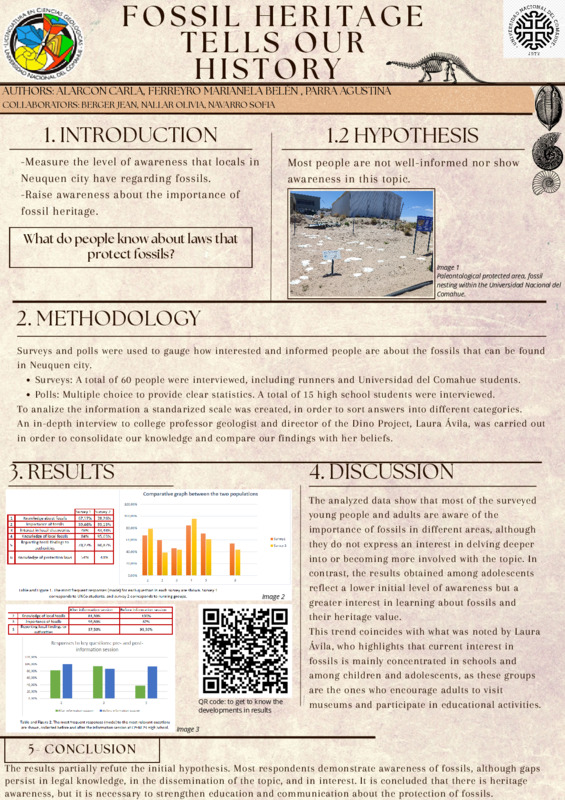
The preservation of fossil heritage constitutes an interdisciplinary challenge that involves geology, education, and the public communication of science. On the campus of the National University of Comahue, where fossils are exposed to the everyday environment, gaps in knowledge and limited dissemination regarding their value and legal protection are observed. In response to this issue, the present study aimed to evaluate the level of awareness and knowledge about fossils among different sectors of the community —university campus users, runners, and high school students— as well as to analyze the impact of an educational intervention on the social perception of fossil heritage.
The research was carried out under a mixed approach, through the application of surveys, interviews, and informative talks. Quantitative data were analyzed using descriptive statistics, while qualitative data were examined through thematic coding. The results indicate that, although adults and university students possess a general awareness of the importance of fossils, their involvement and normative knowledge are limited. In contrast, high school students showed a significant increase in their knowledge and appreciation after participating in a guided educational instance.
Overall, the findings confirm the decisive role of geoscience education as a tool to strengthen social awareness and promote the preservation of fossil heritage. It is recommended to systematically incorporate heritage content into school, university, and community programs in order to foster an informed citizenship committed to its natural and cultural environment.
Leer más
The research was carried out under a mixed approach, through the application of surveys, interviews, and informative talks. Quantitative data were analyzed using descriptive statistics, while qualitative data were examined through thematic coding. The results indicate that, although adults and university students possess a general awareness of the importance of fossils, their involvement and normative knowledge are limited. In contrast, high school students showed a significant increase in their knowledge and appreciation after participating in a guided educational instance.
Overall, the findings confirm the decisive role of geoscience education as a tool to strengthen social awareness and promote the preservation of fossil heritage. It is recommended to systematically incorporate heritage content into school, university, and community programs in order to foster an informed citizenship committed to its natural and cultural environment.
Editor
Universidad Nacional del Comahue. Facultad de Lenguas
Fecha
2025
Materia
Fuente
Durante el año 2025, la Cátedra de Inglés de la Licenciatura en Ciencias Geológicas (Facultad de Ingeniería), a cargo de la profesora María Belén Martínez del Departamento de Idiomas con Propósitos Específicos, desarrolló un trabajo basado en proyectos. A lo largo del cursado, los estudiantes llevaron adelante proyectos de investigación–servicio en los que articularon sus saberes de inglés con los contenidos propios de sus carreras y con la resolución de problemáticas reales de la comunidad. El proceso incluyó la lectura y el análisis de textos académicos en inglés para la elaboración del marco teórico, la selección de un problema relevante, el diseño e implementación de una metodología de investigación, y la comparación de resultados con los aportes de autores especializados. Cada proyecto culminó con la redacción de un informe final en formato de paper, presentado en español e inglés, siguiendo una plantilla estandarizada.
Identificador
Formato
PDF
Derechos
Los autores
Licencia
CC-BY-NC-SA
Visitas:
32
Descargas:
Editor
Universidad Nacional del Comahue. Facultad de Lenguas
Fecha
2025
Materia
Fuente
Durante el año 2025, la Cátedra de Inglés de la Licenciatura en Ciencias Geológicas (Facultad de Ingeniería), a cargo de la profesora María Belén Martínez del Departamento de Idiomas con Propósitos Específicos, desarrolló un trabajo basado en proyectos. A lo largo del cursado, los estudiantes llevaron adelante proyectos de investigación–servicio en los que articularon sus saberes de inglés con los contenidos propios de sus carreras y con la resolución de problemáticas reales de la comunidad. El proceso incluyó la lectura y el análisis de textos académicos en inglés para la elaboración del marco teórico, la selección de un problema relevante, el diseño e implementación de una metodología de investigación, y la comparación de resultados con los aportes de autores especializados. Cada proyecto culminó con la redacción de un informe final en formato de paper, presentado en español e inglés, siguiendo una plantilla estandarizada.
Identificador
Formato
PDF
Derechos
Los autores
Licencia
CC-BY-NC-SA