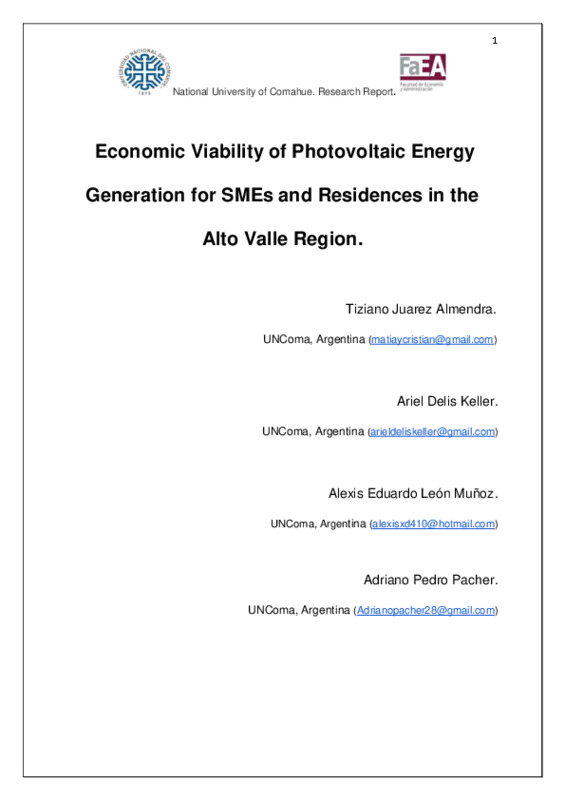
Economic Viability of Photovoltaic Energy Generation for SMEs and Residences in the Alto Valle Region
Archivos
Resumen
This study analyzes the economic and financial viability (feasibility) of investing in distributed generation through photovoltaic solar energy (PV) in the commercial (SME and MSE) and residential sectors of the Alto Valle region of Argentina. The objective is to address the low adoption of renewable energy sources, which is attributed to the lack of appropriate evaluation tools and communication strategies that demonstrate their feasibility. A mixed-design methodology was applied, combining economic-financial analysis with surveys on community perception.
The primary obstacle identified was the high initial cost of the equipment. Furthermore, 78.8% of respondents were unaware of financing models such as solar leasing or specific credits. The dominant concern was exchange rate variability (66.7%), surpassing the local interest rate, because system components are priced in US dollars. Despite these barriers, financial indicators, such as Net Present Value (NPV) and Internal Rate of Return (IRR), confirmed the project's viability. Even before the training, 63.6% already considered it viable. The study concludes that it is crucial to strengthen the diffusion of financial and regulatory knowledge (such as Law N° 27.424). Training activities improved the perception of viability and increased the intention to adopt photovoltaic technology.
Leer más
The primary obstacle identified was the high initial cost of the equipment. Furthermore, 78.8% of respondents were unaware of financing models such as solar leasing or specific credits. The dominant concern was exchange rate variability (66.7%), surpassing the local interest rate, because system components are priced in US dollars. Despite these barriers, financial indicators, such as Net Present Value (NPV) and Internal Rate of Return (IRR), confirmed the project's viability. Even before the training, 63.6% already considered it viable. The study concludes that it is crucial to strengthen the diffusion of financial and regulatory knowledge (such as Law N° 27.424). Training activities improved the perception of viability and increased the intention to adopt photovoltaic technology.
Editor
Universidad Nacional del Comahue. Facultad de Lenguas
Fecha
2025
Materia
Fuente
Durante el año 2025, la Cátedra de Inglés de la Facultad de Economía, a cargo de la profesora María Belén Martínez del Departamento de Idiomas con Propósitos Específicos, desarrolló un trabajo basado en proyectos. A lo largo del cursado, los estudiantes llevaron adelante proyectos de investigación–servicio en los que articularon sus saberes de inglés con los contenidos propios de sus carreras y con la resolución de problemáticas reales de la comunidad. El proceso incluyó la lectura y el análisis de textos académicos en inglés para la elaboración del marco teórico, la selección de un problema relevante, el diseño e implementación de una metodología de investigación, y la comparación de resultados con los aportes de autores especializados. Cada proyecto culminó con la redacción de un informe final en formato de paper, presentado en español e inglés, siguiendo una plantilla estandarizada.
Identificador
Derechos
Los autores
Licencia
CC-BY-NC-SA
Visitas:
38
Descargas:
1
Editor
Universidad Nacional del Comahue. Facultad de Lenguas
Fecha
2025
Materia
Fuente
Durante el año 2025, la Cátedra de Inglés de la Facultad de Economía, a cargo de la profesora María Belén Martínez del Departamento de Idiomas con Propósitos Específicos, desarrolló un trabajo basado en proyectos. A lo largo del cursado, los estudiantes llevaron adelante proyectos de investigación–servicio en los que articularon sus saberes de inglés con los contenidos propios de sus carreras y con la resolución de problemáticas reales de la comunidad. El proceso incluyó la lectura y el análisis de textos académicos en inglés para la elaboración del marco teórico, la selección de un problema relevante, el diseño e implementación de una metodología de investigación, y la comparación de resultados con los aportes de autores especializados. Cada proyecto culminó con la redacción de un informe final en formato de paper, presentado en español e inglés, siguiendo una plantilla estandarizada.
Identificador
Derechos
Los autores
Licencia
CC-BY-NC-SA